A Brief Introduction to Bhagavad Dharma
Bhagavad Dharma: The Religion Revealed by God in the Bhagavad Gita
Founder of this Religion
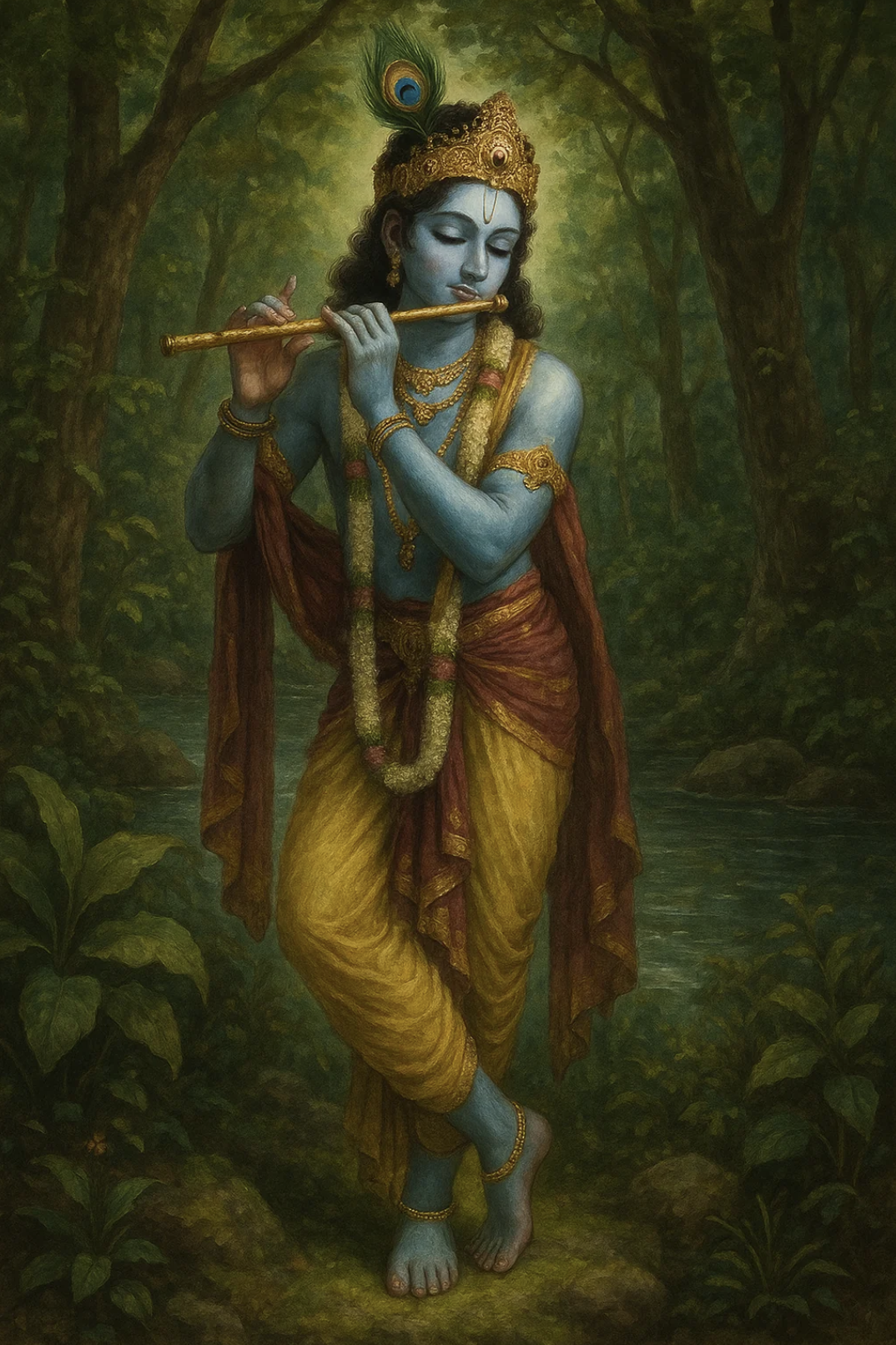
Bhagavan Krishna, through the Bhagavad Gita.
Principal Scripture
The Bhagavad Gita
Highest Deity for Worship
Lord Vishnu, and His two human incarnations, Bhagavan Rama and Bhagavan Krishna.
Supplementary Texts
The Ramcharitmanas and the Bhagavata Purana are accepted as supplementary texts, but only to the extent that they do not contradict the teachings of the Bhagavad Gita. In particular, any uncharitable or degrading statements about women or Shudras (the labouring classes) that may appear in some popular editions are not accepted as valid guidance in Bhagavad Dharma. It must be remembered that these two all-time great sacred works, which have few parallels in the Sanatan tradition, were authored by some of the most widely accepted and revered saints. At the same time, it is also recognised that, over long periods of transmission, some interpolations may have entered certain versions of these texts.
The Five Doctrinal Pillars
एकः ईश्वरः नारायणः
There is one God: Narayana
एकं शास्त्रं भगवद्-गीता
There is one supreme scripture: the Bhagavad Gita.
एकं लक्ष्यं दिव्यं सुखम्
There is one goal: divine bliss.
एकः पन्थाः समन्वययोगः
There is one path: the harmony of devotion, spiritual knowledge, and detached action.
एकः समाजः जातिविहीनः
There is one society: free from caste distinctions.
Bhagavad Dharma on:
Varna and Human Equality
Bhagavad Dharma does not accept birth-based varna. In practice, birth-based varna has already collapsed due to legal and social change. Bhagavad Dharma affirms basic respect for all human beings, and greater respect for those who are truly knowledgeable and spiritually refined. In this sense, "Brahmin" is understood by qualities described in the Gita, not by lineage.
Sadhana Path (Spiritual Practice)
Loving devotion (bhakti), with complete surrender to the Ishta Deva, supported by spiritual knowledge and karma-yoga (right action and duty performed with purity, detachment, and surrender). Bhakti is fundamental.
Worship of Other Divine Forms
Bhagavad Dharma follows ekanta-ananya bhakti, single-minded devotion to the chosen Ishta Deva. At the same time, it permits respectful, occasional homage to other divine forms such as kula-devata or grama-devata as part of family or local tradition. Occasional homage may also be offered to other deities, in accordance with Bhagavad Gita 17.14, which speaks of "pujanam" (honouring) of devas as well as dvija, guru, and the wise. Since the verse applies "puja" to both divine beings and human beings, "puja" here should be understood as ritual honour or respectful homage, not as upasana, that is, whole-life devotion to a deity.
However, seekers are advised not to approach these forms for boons or wish-fulfilment. Requests and surrender are directed to the Ishta Deva alone. Developing emotional intimacy with any divine form other than the Ishta Deva is regarded as spiritual infidelity and is considered a sin.
Unity of Sri Vishnu, Sri Rama, and Sri Krishna
Bhagavad Dharma regards Sri Vishnu, Sri Rama, and Sri Krishna as one Hari. Vishnu is the source (amshi), and Rama and Krishna are His manifestations (amsha). But treat both Sri Rama and Sri Krishna as "Poorn Brahm." Those who worship Sri Rama or Sri Krishna as Ishta Deva are, in essence, worshipping Bhagavan Vishnu through that chosen form, according to their natural attraction and temperament. The harmony of these three is captured in the following guiding principle: श्रीकृष्णस्य वाणी— The words (teachings) of Sri Krishna. श्रीरामस्य चरित्रम्— The character and conduct of Sri Rama. श्रीहरेः शरणागतिः— Surrender to Sri Hari.
Guru
Bhagavad Dharma does not recognise a human guru as spiritually necessary or binding. The supreme Guru is Bhagavan Krishna's teaching itself. The Bhagavad Gita is treated as the Purna Guru Granth, the complete and sufficient guide, as expounded in Brahm Bodhi's commentaries. To preserve the integrity, purity, and continuity of this spiritual stream, no other person in this tradition is authorised to compose an official commentary on the Bhagavad Gita.
Brahm Bodhi the Pratham Pragya
Brahm Bodhi is recognised as the first modern expositor of Bhagavad Dharma and the head of the Bhagavad Dharma Spiritual Order. He is designated Pratham Pragya (the first guide of this renewed exposition). Pratham Pragya is functionally equivalent to what other traditions may call a human guru, but followers of Bhagavad Dharma do not use the title "Guru" for him, even if others do so out of habit or unfamiliarity with Bhagavad Dharma's discipline. They address him as "Pratham Pragya".
Succession
Succession will be decided according to the will and guidelines laid down by Brahm Bodhi, Pratham. His successor will be known as the next Pratham Pragya, but will not automatically be called "Brahm Bodhi". The title "Brahm Bodhi" will be reserved for a Pratham Pragya who meets the qualifications specified by Brahm Bodhi. These qualifications will be recorded formally in his handwritten will, to be disclosed after his demise by surviving members of his family, with whom the document will remain in custody.
In the future, as the tradition matures and a strong body of enlightened and devoted practitioners emerges, a council may be constituted to select the next Pratham Pragya through a structured, confidential, and deliberative process, with clearly defined eligibility, solemn consultation, and a decisive internal ballot, conducted until a clear choice commands the council's assent. The same body would also determine whether the honorific "Brahm Bodhi" may be conferred, strictly in accordance with the criteria laid down by Brahm Bodhi, Pratham in his will.
Conversion
Conversion into Bhagavad Dharma is permitted through an open, lawful, and ethical process. The tradition emphasises self-conversion through study, reflection, and voluntary adoption of the Bhagavad Gita's philosophy, spiritual discipline, and life-vision. No coercion, inducement, or unlawful means are permitted.
Duty of Every Bhagavad Dharmi
1. To follow the Bhagavad Gita sincerely in thought, conduct, and daily practice. 2. To help others understand and adopt Bhagavad Dharma through lawful and ethical means, primarily by transforming thought and character through knowledge and example. Followers are encouraged, as a life goal, to inspire at least five people to adopt Bhagavad Dharma voluntarily.
Bhagavad Dharma's purpose is to offer humanity a clear, ethical, compassionate, and spiritually profound path, free from confusion, coercion, hatred, and dehumanisation. It also seeks to reduce the influence of belief systems that do not promote universal love, brotherhood, human happiness, mutual respect, and reverence for life, and that instead create social division, suppress women, exploit the poor and vulnerable, deny human dignity, legitimise violence, justify cruelty toward living beings, or sustain injustice and exploitation.