Delve into the simple answers to major allegations against Sanātana Dharma, from the practice of ancestor worship (pitṛ-pūjā) to the true meaning of pūjā itself. Uncover the nuances behind these misunderstood traditions.
Major Allegations Against Sanātana Dharma and Their Simple Answers
1. Ancestor Worship (Pitṛ-Pūjā)
The Allegation:
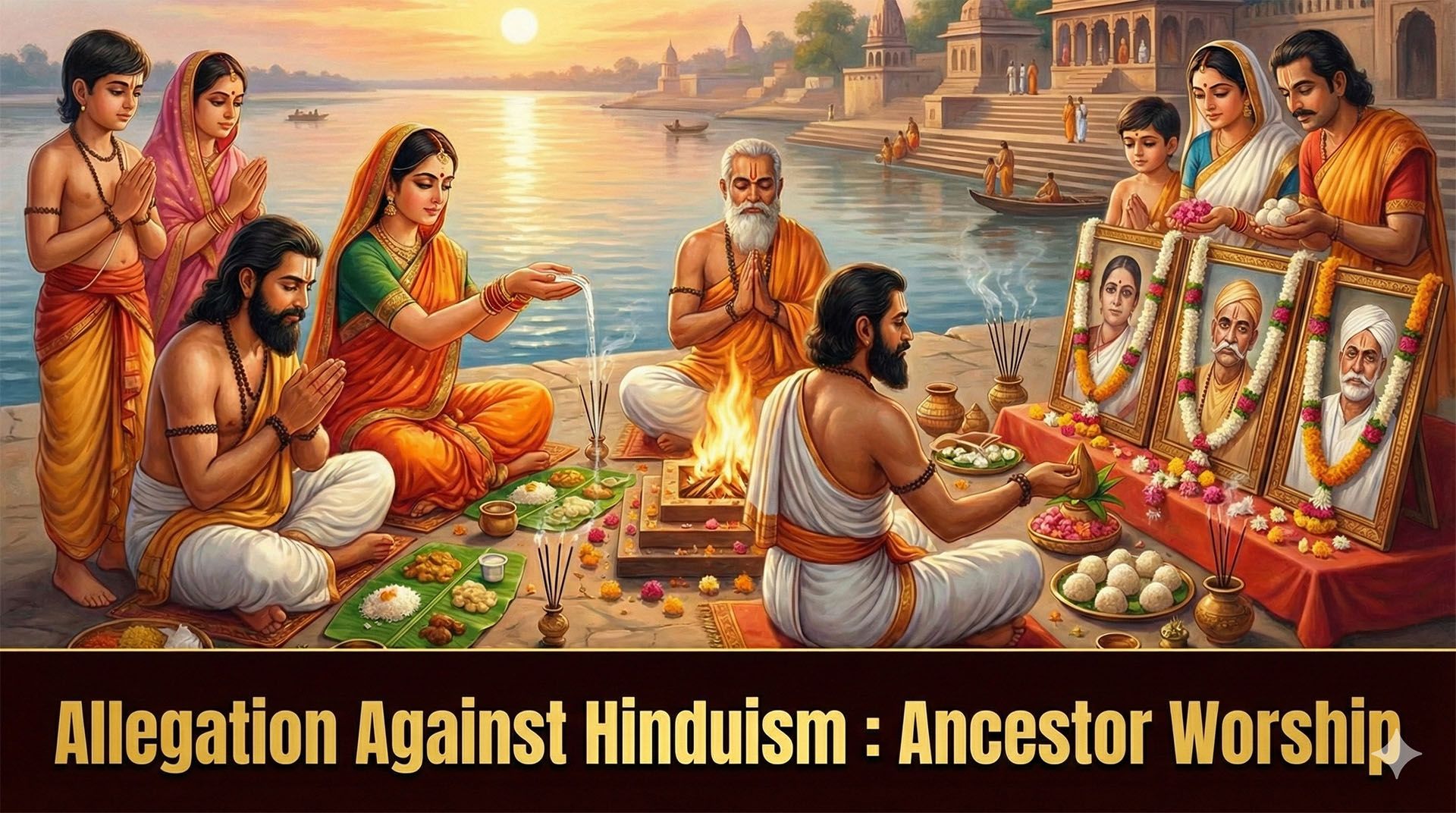
It is often alleged that Hindus keep photographs of their ancestors, garland them, light incense before them, and thus “worship human beings in place of God,” a practice described as “ancestor worship” (pitṛ-pūjā).
The Answer:
The word pūjā is derived from the Sanskrit root pūj, whose original meaning is respect, honor, and reverential hospitality. Pūjā does not mean “to turn someone into God,” but rather to show respect to one in whom divinity, knowledge, virtue, or excellence is perceived. For this reason, the same word is used for honoring parents, honoring one’s teacher, honoring a guest, and honoring a deity.
When the Bhagavad Gītā states:
Devadwijaguruprājña-pūjanaṃ śaucam ārjavam
brahmacaryam ahiṃsā ca śārīraṃ tapa ucyate (17.14)
देवद्विजगुरुप्राज्ञपूजनंशौचमार्जवम्ब्र
ह्मचर्यमहिंसा च शारीरं तप उच्यते॥ (17.14)
it uses the word pūjana precisely in this sense of honor and respect. This is because the Gītā has already discouraged the worship (upāsanā) of anyone other than the Supreme Reality, as it states elsewhere:
Yānti deva-vratā devān pitṝn yānti pitṛ-vratāḥ
bhūtāni yānti bhūtejyā yānti mad-yājino’pi mām” (9.25)
यान्ति देवव्रता देवान् पितॄन् यान्ति पितृव्रताः।
भूतानि यान्ति भूतेज्या यान्ति मद्याजिनोऽपि माम्॥ (9.25)
That is, those who dedicate themselves to the gods attain the realms of the gods; those devoted to the ancestors attain the realm of the ancestors; those who worship lower beings attain corresponding states of existence; and those who worship and surrender to Me, making Me their ultimate goal, attain Me and My abode. For this reason, the worshippers of the Supreme do not undergo rebirth.
Sanskrit employs several distinct terms, and in this context it is essential to understand the difference between pūjā and upāsanā. Pūjā is an act of offering and respect—offering flowers, lamps, incense, garlands, or cloth. Upāsanā, on the other hand, is devotion and surrender—complete inner self-surrender to God.
Placing a garland on an ancestor’s photograph or lighting incense in a Hindu home is therefore not upāsanā or worship of God. It is a cultural gesture of respect, just as one may garland a teacher, place flowers before the statue of a great person, light a lamp before the photograph of a martyr, or salute the national flag. In all these cases, the act expresses reverence, gratitude, and remembrance, not worship.
Every culture has its own ways of expressing respect—joining the hands in greeting, bowing, saluting, kissing the hand, or offering flowers. Thus, placing a garland or incense before an ancestor’s photograph is not equating them with God, but a cultural expression of gratitude and respect toward one’s family lineage.
Śrāddha and tarpaṇa are not forms of ancestor worship, but rituals of welfare and well-being. They are religious rites performed for the peace, upliftment, and auspicious progress of departed ancestors. Just as a person gives medicine to a patient in a hospital, śrāddha involves prayers and ritual actions performed for the benefit of the souls of ancestors. For example, tarpaṇa is a very simple act in which water is offered with joined palms for deceased ancestors, with the intention that they may attain satisfaction and peace.
The cultural significance of this practice is often illustrated by a statement attributed to Emperor Shah Jahan, in which he is said to have remarked to his son Aurangzeb: “Look at the Hindus— even after death, they perform śrāddha and tarpaṇa for the welfare of their ancestors, whereas you imprison your father during his lifetime and subject him to various forms of suffering.