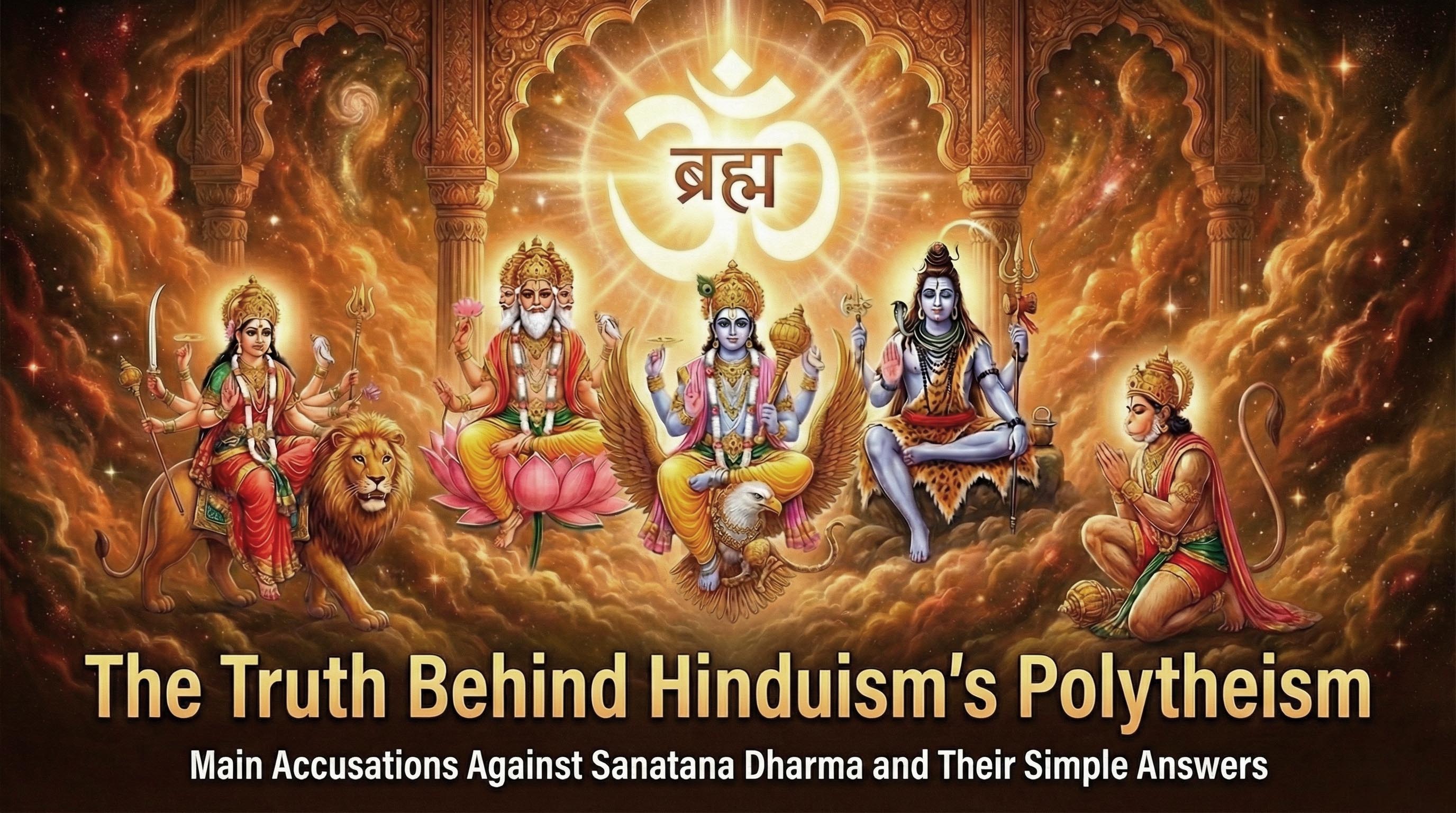
Beyond the surface of 'many gods,' the essence of Hinduism reveals a profound understanding of the Supreme Lord. Delve into this thought-provoking examination of the singular Brahman and its diverse manifestations.
Main Accusations Against Sanatana Dharma
and Their Simple Answers
Charge 1
Charge: Among the main accusations levelled against Sanatana Dharma, the first is that in Hinduism many gods are worshipped; it is not monotheistic, but a polytheistic religion.
Answer
This charge is factually incorrect.
In Hinduism, God is understood to be one, called Brahman or Parabrahman, although there are many deities, just as in the Abrahamic religions, God is one, but there are many angels. Angels and devas (gods) are both creations of God and are subordinate to Him. Both exist to serve God and His creation, although angels are not worshipped, whereas devas are worshipped as well. Because a large number of devas are worshipped, the illusion is created that Hinduism believes in many independent gods.
The Supreme Lord, that is, Brahman (not “Brahma,” who is a deity), is formless and without attributes (beyond the three qualities of nature—sattva, rajas, and tamas). Apart from that Brahman there is no other reality at all. That Brahman, from time to time, creates the world and the universe, and then dissolves them again. The cycle of creation and dissolution goes on continuously.
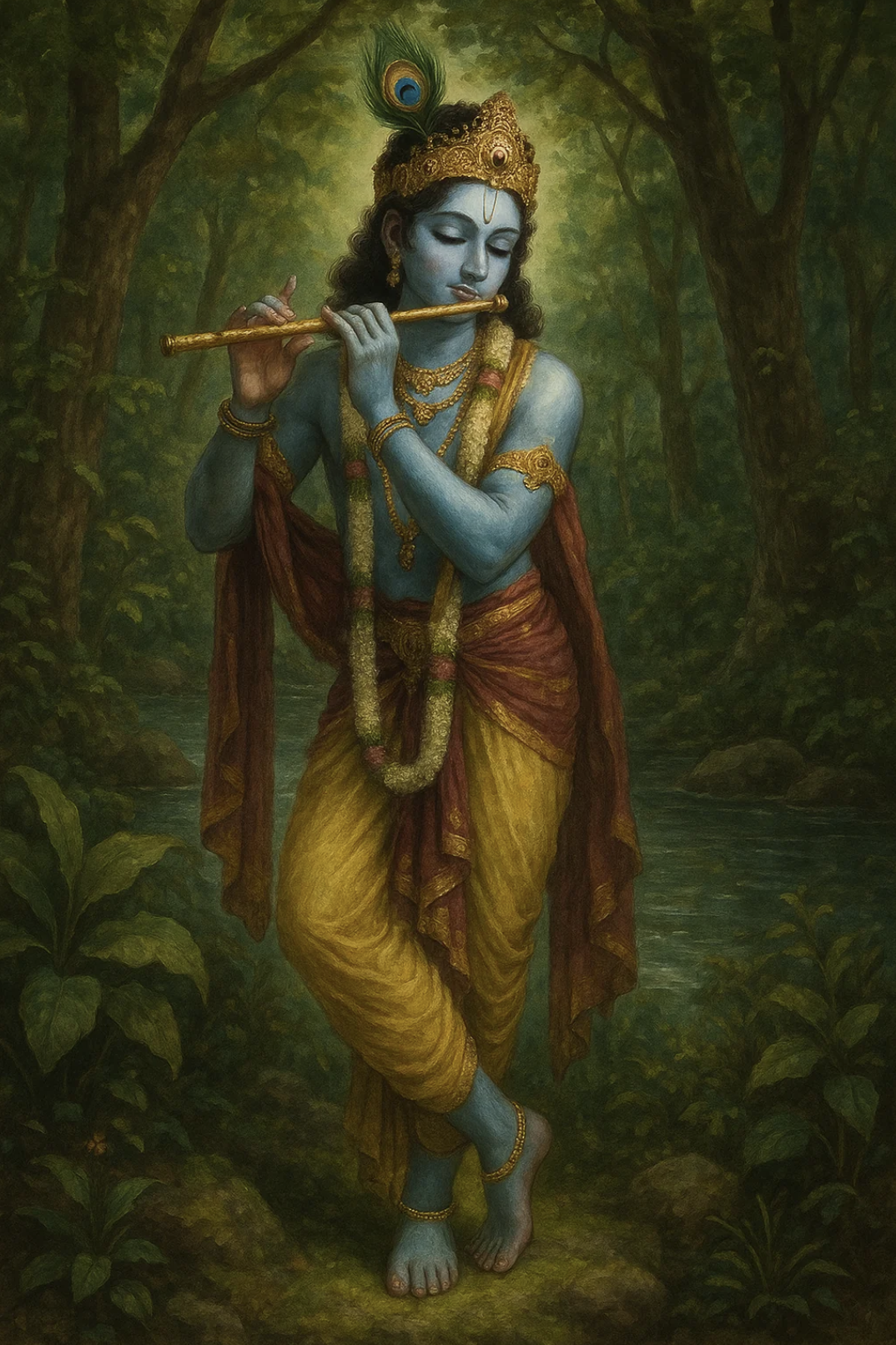
When creation takes place, that same formless Supreme Being appears within the created order as the personal, qualified God (saguna Brahman) with form (for example, Lord Vishnu), and from time to time descends into the world in the form of incarnations (avatāras), such as Lord Krishna. But all these personal forms—whether Vishnu, Shiva, or Shakti—merge back into that same formless Supreme (Brahman) at the end of the cosmic cycle. Nature itself and the entire universe also dissolve into that formless Supreme Lord. Then nothing else remains—only that one Brahman, the formless Brahman, the Supreme Lord.
Thus, in Hinduism the concept of God is understood in the following sequence:
Formless, attribute‑less Brahman ◊ Personal God with form and attributes (saguna Brahman) ◊ The manifested, personal incarnations of God (such as Shri Rama, Shri Krishna).
Therefore, in Hinduism God is not many, but one; only His manifestations are many. It is completely a monotheistic religion in this sense. As stated, there is only one God, although there are many devas. Devas, like humans and animals, are also creations of God. Devas are indeed divine and powerful, but they are not all‑powerful. They are like countless waves of that one ocean‑like Supreme Lord—not independent, but entirely subject to Him.
It is also worth noting that in other religious traditions too, God has been explained through multiple “aspects” or “persons.” For example, in the Christian tradition, God is understood as the Trinity of God, the Son, and the Holy Spirit; yet this is still regarded as one God. In this, Jesus, while being in human form, is still accepted as a manifestation or person of the one God. In a similar way, in Hinduism there is a three‑tiered understanding: the formless, attribute‑less Brahman; the personal God with form and attributes; and the incarnations (avatāras).
This position is confirmed by all the major scriptures.
Therefore, Sanatana Dharma or Hinduism is a monotheistic religion.
(To be continued)