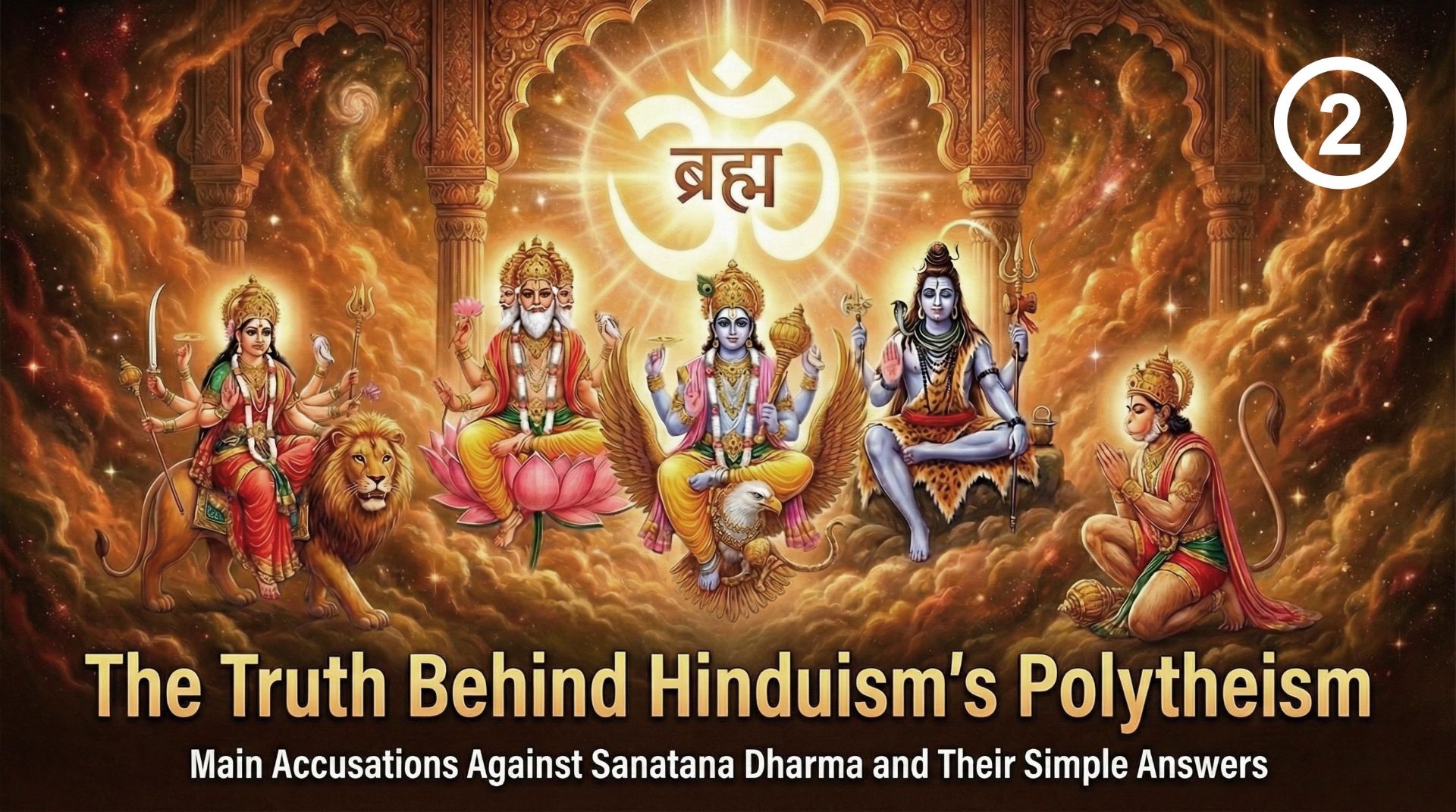
Understand, through scriptural evidence, how Hinduism affirms one Supreme God, with many subordinate deities who serve Him and oversee His creation.
Response to the allegation of polytheism (Part 2)
(In the first part of the response to the allegation of polytheism, the subject was presented in a simple manner. However, considering the great importance of the topic, it is necessary to add here a brief—though not excessive—scriptural discussion. Readers with special interest should certainly read this, as it will be of considerable help in explaining matters to learned priests and maulvis and in responding to them.)
In the Hindu tradition, unlike Christianity and Islam, there is no formally declared and institutionally fixed canon (a universally accepted authoritative body of scripture). Christianity has a single authoritative scripture, the Bible, whereas Islam has a multi-tiered scriptural structure. In Islam, the Qur’an is regarded as the primary canonical text (primary canon). After it, six collections of sound (ṣaḥīḥ) Hadith, including Ṣaḥīḥ Bukhārī and Ṣaḥīḥ Muslim, are accepted as a secondary canon. In addition, hundreds of other Hadith collections are placed at a tertiary level (tertiary corpus), whose authority and binding force are considered limited.
Hinduism too possesses hundreds of texts, yet their authority is not regarded as equal.
In the Vedānta tradition, the Prasthāna-trayī—comprising 10–12 principal ancient Upaniṣads, the Brahma Sūtras, and the Bhagavad Gītā—is considered the decisive doctrinal foundation and the core philosophical canon. The major ācāryas have written commentaries only on these texts. Although the Vedic Saṁhitās fall under śruti, they are primarily ritualistic and symbolic in nature, whereas systematic philosophical exposition is found in the Upaniṣads. Hence, the Upaniṣads are regarded as the jñāna-kāṇḍa (knowledge section) of the Vedas and their theoretical representatives. The Rāmāyaṇa and the Mahābhārata, along with the Manusmṛti and the principal eighteen Purāṇas, may be called secondary authoritative texts. Their purpose is not to establish philosophy but to provide practical guidance in dharma, devotion, and social life. Tantras, Āgamas, minor Purāṇas, saint literature, and regional texts belong to the tertiary level, whose importance is cultural, experiential, or sectarian.
Thus, just as the abundance of Hadith literature in Islam does not negate the unity of the Qur’an, similarly, the multiplicity of texts in Hinduism does not undermine its unified philosophical foundation. Rather, it reveals its multilayered and inclusive intellectual tradition.
To see how the concept of one fundamental God is established from the primary authoritative scriptures (the core canon), the following passages may be examined.
Core Principle: The Supreme Truth/God is one and is beyond form (unmanifest/formless).
The Gītā clearly describes the essential nature of God using terms such as avyakta (unmanifest), akṣara (imperishable), anirdeśya (indefinable), and nirguṇa (without attributes). This means that the Supreme Being is not confined to any single limited form, but transcends all forms.
Gītā 12:3–4
“Those who worship the imperishable, indefinable, unmanifest, all-pervading, inconceivable, unchanging, immovable, and eternal principle… they too attain Me alone.”
Logical conclusion: Worship of the formless/unmanifest Supreme Principle also leads “to Me alone”; therefore, the ultimate goal is one.
Gītā 9:4
“By My unmanifest form this entire universe is pervaded. All beings abide in Me, but I am not confined within them.”
Logical conclusion: God pervades the universe but is not bound by any limited form or body.
Gītā 7:24
“The unintelligent think of Me, who am unmanifest, as having become manifest; they do not know My higher, imperishable nature.”
Logical conclusion: To confine the unmanifest Supreme Reality solely to a manifest form is ignorance.
Deities versus God: Deities may be many, but the Supreme God is one.
The main confusion arises when “deities” are mistaken for “God.” The Gītā clearly states that even in the worship of deities, the giver of results is that one Supreme God; deities are not independent, omnipotent Supreme Beings.
Gītā 7:21–22
“Whichever form a devotee seeks to worship with faith, I stabilize that very faith; endowed with that faith, he worships that form and obtains the desired results, which are indeed granted by Me alone.”
Logical conclusion: Deities are not independent ultimate grantors of results; the grantor is one Supreme God.
The Vedas: “Ekaṁ sat…”—the Vedas themselves dispel the illusion of polytheism.
The Vedas mention names such as Indra, Agni, Varuṇa, Mitra, and Soma, which can create the impression of polytheism. However, the Ṛgveda itself decisively resolves this misunderstanding:
Ṛgveda 1.164.46
“Truth is one; the wise speak of it in many ways—they call it Agni, Yama, Mātariśvan.”
Logical conclusion: “Truth is one” is the Vedic declaration; names and forms are many, but the ultimate reality is one.
The Upaniṣads: Philosophical unity is made explicit through “ekam eva advitīyam” and “neha nānāsti kiñcana.”
If the Vedic Saṁhitās employ more hymnic, ritualistic, and symbolic language, the Upaniṣads present the philosophical conclusions of that very śruti, repeatedly declaring oneness (non-duality).
Chāndogya Upaniṣad 6.2.1
“Ekam eva advitīyam” — “That Reality is one, without a second.”
Logical conclusion: If the Supreme Reality has no second, the idea of multiple independent Gods is impossible.
Bṛhadāraṇyaka Upaniṣad 4.4.19
“Neha nānāsti kiñcana” — “There is no multiplicity here whatsoever.”
Logical conclusion: At the level of ultimate truth, multiplicity is denied; polytheism is thereby negated.
Chāndogya Upaniṣad 3.14.1
“Sarvaṁ khalv idaṁ brahma” — “All this indeed is Brahman.”
Logical conclusion: If everything is pervaded by the one Brahman, then deities too are to be understood as within or subordinate to that one Supreme Reality, not as independent Gods.
Regarding the debate over whether Śrī Viṣṇu or Śrī Śiva is the supreme saguṇa (with attributes) form of God, it should be understood that the Bhāgavata Purāṇa, the highest Purāṇa of the Vaiṣṇavas, explains in detail (Third Skandha, Fifth Chapter) how the Supreme, formless Brahman assumed form as Śrī Viṣṇu (Nārāyaṇa) at the beginning of creation. His limbs manifested one by one, culminating in the complete form of Nārāyaṇa. Thus, the source of Śrī Viṣṇu is also the same formless Supreme Brahman. Similarly, in the Śaiva tradition, the Śiva Purāṇa describes the manifestation of Sadāśiva from the formless Supreme Reality.
The Śiva Purāṇa further explains beautifully that across different cycles of creation, the Supreme Being establishes at times Śrī Viṣṇu, at times Śrī Brahmā, and at times Śrī Śiva as the highest saguṇa form.
Rudra Saṁhitā, Sṛṣṭi Khaṇḍa, 16–18:
[Paraphrase:] The Supreme, all-pervading, all-seeing, causal, venerable, primordial, bestowing and purifying Reality willed to manifest a form, and from that will emerged the pure-natured divine form. That unique, beginningless and endless Reality, luminous, of pure consciousness (cit), called Parabrahman, all-pervading and imperishable, manifested. The manifest form of that formless Supreme Reality is Sadāśiva. The wise of ancient and later ages have sung of Him as “Īśvara.”
This passage identifies Parabrahman as the source of Śiva.
It must be remembered that the saguṇa forms that manifest within cycles of creation also dissolve at the end of those cycles. Thus, Śrī Viṣṇu, Sadāśiva, and all such manifest forms ultimately merge back into their original formless Parabrahman.
Then there remains only that one formless Supreme Brahman.
Conclusion
(a) The Gītā accepts the unmanifest/formless/attributeless Supreme Principle and teaches that the giver of results in all forms of worship is the same one God.
(b) The Vedas decisively declare: “Truth is one; names are many.”
(c) The Upaniṣads philosophically proclaim: “One without a second” and “There is no multiplicity here.”
Therefore, the doctrinal foundation of Hinduism is not polytheism but unity (one God, one Supreme Principle). Deities may be many, but they are diverse functional or devotional names and forms, or subordinate levels of authority of that one Supreme God, not independent, omnipotent “many Gods.”