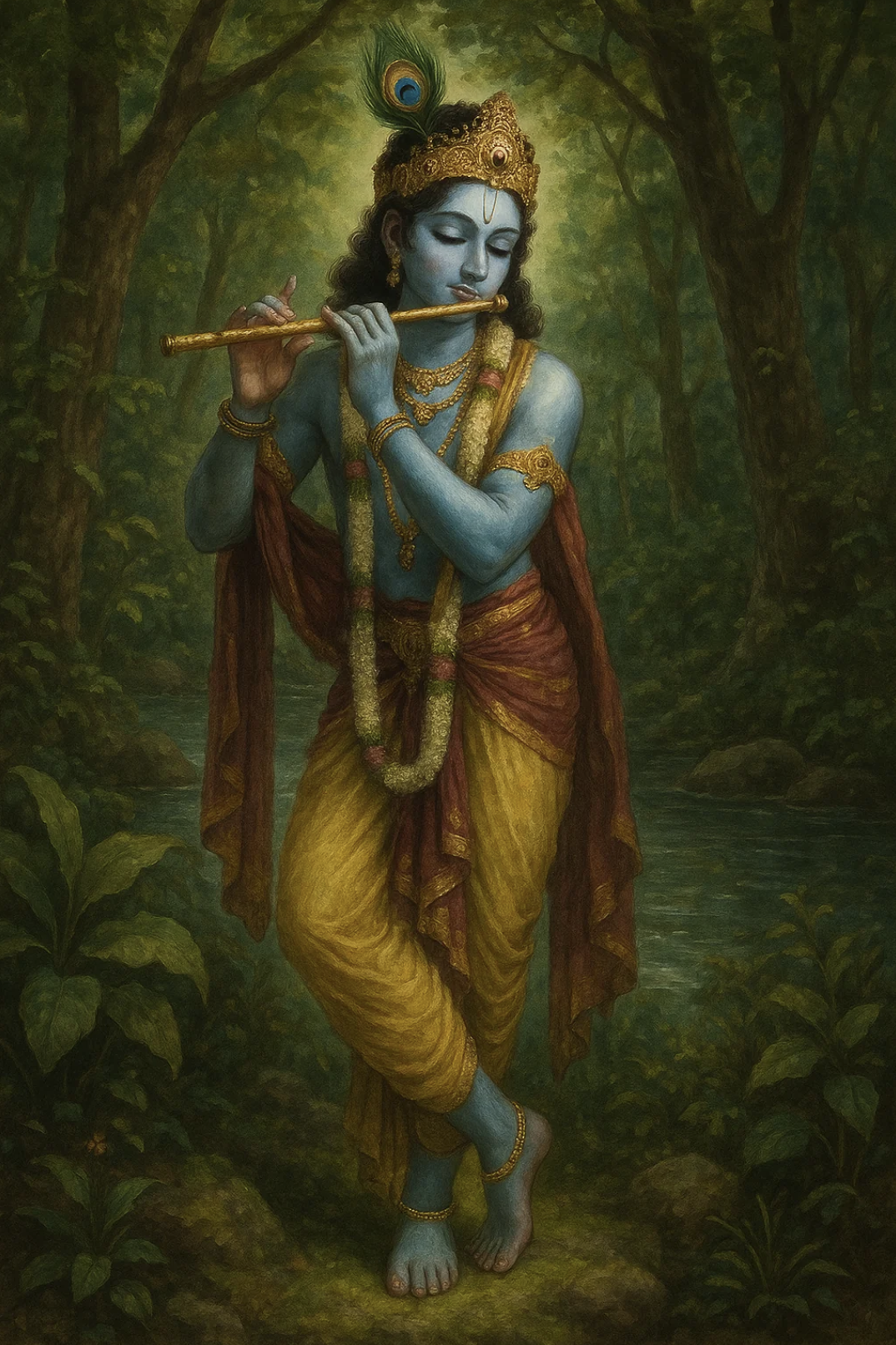

In his previous reflection, BrahmBodhi had promised to say a few words about the eight clear principles of Bhagavad Dharma — the way Islam presents its five pillars. Responding to readers' curiosity, he opens here a small window into Bhagavad Dharma: eight simple, memorable aphorisms that set out its worldview and ethical direction, to be grasped before any question of religious conduct.
In his earlier article, BrahmBodhi recalls, he had referred to the first part of the series “A Critical Reflection on Sanatan Dharma’s Sense of Duty and Ethical Outlook.” At its close he had observed that, just as Islam has established five fundamental pillars to present the religious duties of its followers in a concise and clear form, Bhagavad Dharma has likewise formulated eight clear principles to guide its own followers.
This, he notes, was not strictly the occasion to discuss Bhagavad Dharma, since the present series concerns Sanatan Dharma’s sense of duty and ethical outlook. Bhagavad Dharma is itself a branch of Sanatan Dharma, though its worldview differs somewhat from that of mainstream Sanatan Dharma. Yet several readers at once expressed curiosity — some even offered their own guesses — about what these principles were. Keeping that curiosity in mind, he opens a small window into Bhagavad Dharma.
A worldview before conduct
In BrahmBodhi’s view, the establishment of the Five Pillars of Islam has been a significant achievement; no comparable universal framework is found in either Sanatan Dharma or Christianity. Yet, he says, those five principles do not tell the whole story. Before telling a person which practices are obligatory — namaz, roza, Hajj — it is necessary to clarify what direction life itself should take: towards what goal is one moving, and by what ethical ideals should life be guided?
In other words, a worldview must precede conduct. Ethical direction must come first; only when one’s worldview is clear can one’s conduct acquire its full meaning. One may even hear certain clerics claim that if a person offers the five daily prayers he may then do as he wishes and all will be forgiven. Before prescribing religious conduct, therefore, Bhagavad Dharma first defines its worldview and ethical direction through eight simple, memorable aphorisms.
The eight guiding principles
- एकः ईश्वरः नारायणः — Ekaḥ Īśvaraḥ Nārāyaṇaḥ — One Supreme God: Narayana.
- एकं शास्त्रं भगवद्गीता — Ekaṁ Śāstraṁ Bhagavadgītā — One guiding scripture: the Bhagavad Gita.
- एकं लक्ष्यं दिव्यं सुखम् — Ekaṁ Lakṣyaṁ Divyaṁ Sukham — One ultimate goal: Divine Happiness.
- एकः पन्थाः समन्वययोगः — Ekaḥ Panthāḥ Samanvaya Yogaḥ — One path: the Yoga of Harmonious Integration.
- एकः समाजः जातिविहीनः — Ekaḥ Samājaḥ Jātivihīnaḥ — One society: a casteless society.
- श्रीकृष्णस्य वाणी — Śrīkṛṣṇasya Vāṇī — The teachings of Sri Krishna.
- श्रीरामस्य चरित्रम् — Śrīrāmasya Caritram — The character of Sri Rama.
- श्रीहरेः शरणागतिः — Śrīhareḥ Śaraṇāgatiḥ — Surrender to Sri Hari.
Every follower of Bhagavad Dharma, BrahmBodhi says, knows these eight principles by heart, just as the followers of Islam know their Five Pillars. Together, these eight aphorisms present the fundamental worldview and ethical direction of Bhagavad Dharma.
One scripture — supported by two more
As for the second principle, the Bhagavad Gita — besides being the direct word of God — represents a remarkable synthesis of metaphysics, epistemology, and ethics, including the sense of duty, bringing together practical life-management and the knowledge of liberation (Moksha Vidya). Yet it is a book of principles, and to understand principles one also needs living examples of character. Sri Krishna’s own life is such an example, though not equally easy for an ordinary person to comprehend. For this reason Bhagavad Dharma also draws upon two supplementary texts — the Sri Ramcharitmanas and the Bhagavata Purana — but only insofar as they do not contradict the principles of the Gita.
One ultimate goal: Divine Happiness
The principle Ekaṁ Lakṣyaṁ Divyaṁ Sukham is crucial in defining the purpose of life, BrahmBodhi explains. Unless the ultimate goal is clear, the direction of our various actions cannot be clear either. Bhagavad Dharma’s answer is that the ultimate goal of life is happiness — but not ordinary happiness: it is Divine Happiness. And the purpose of life is not merely to attain happiness for oneself, but also to bring happiness to others.
Worldly and sensory pleasures too have their place; enjoying them is not forbidden. But a human being should not remain confined to sensory pleasure alone — he should seek Divine Happiness. And this Divine Happiness, BrahmBodhi emphasises, is not attainable only after death. Divinity exists here and now, in this very life and this very world; we must recognise and experience it. Thus Bhagavad Dharma directs human life towards Divine Happiness.
One path: the Yoga of Harmonious Integration
But how is this Divine Happiness to be attained? Hence the guidance Ekaḥ Panthāḥ Samanvaya Yogaḥ — “One Path: the Yoga of Harmonious Integration.” BrahmBodhi unfolds it in three movements:
- Integrate knowledge, action, and devotion in one’s spiritual pursuit of God.
- Establish harmony among the different sections of society.
- Cultivate an outlook of harmonious integration among the different peoples, races, and communities of the world.
Harmony produces concord, not conflict — whereas there are religions that teach conflict rather than harmony. This outlook of harmonious integration becomes both a path to God-realisation and a foundation for peace, goodwill, and happiness in worldly life.
One society: a casteless society
Ekaḥ Samājaḥ Jātivihīnaḥ — “One Society: a Casteless Society” — leads towards a casteless and egalitarian social order. This accords with the Bhagavad Gita’s teaching of equal vision and equanimity: a person’s social standing should not be determined by birth.
Narayana — and His incarnations
In Bhagavad Dharma, BrahmBodhi clarifies, Narayana alone is the Supreme God; Sri Rama and Sri Krishna are His incarnations. From the standpoint of spiritual practice, all three are manifestations of the Supreme Brahman in His fullness. Whether one worships Sri Vishnu, Sri Rama, or Sri Krishna, all three are Narayana Himself — yet each has a distinctive role in guiding human life:
- Follow the teachings of Sri Krishna, for in the Bhagavad Gita He has explained at length the principles of life, Dharma, action, knowledge, and spiritual practice — a systematic philosophical discourse that Sri Rama did not deliver.
- Follow the character of Sri Rama, for His life and conduct are more accessible, comprehensible, and worthy of emulation for an ordinary human being.
- Remain surrendered to Sri Hari — for surrender to Sri Rama, to Sri Krishna, or to Sri Vishnu is surrender to the same one Supreme God.
Thus these eight principles place a clear direction for life before every follower of Bhagavad Dharma. The question that now arises — what our daily conduct should be in accordance with this worldview — BrahmBodhi reserves for another occasion. In the next post, he says, the series will return to its original theme: “A Critical Reflection on Sanatan Dharma’s Sense of Duty and Ethical Outlook.”