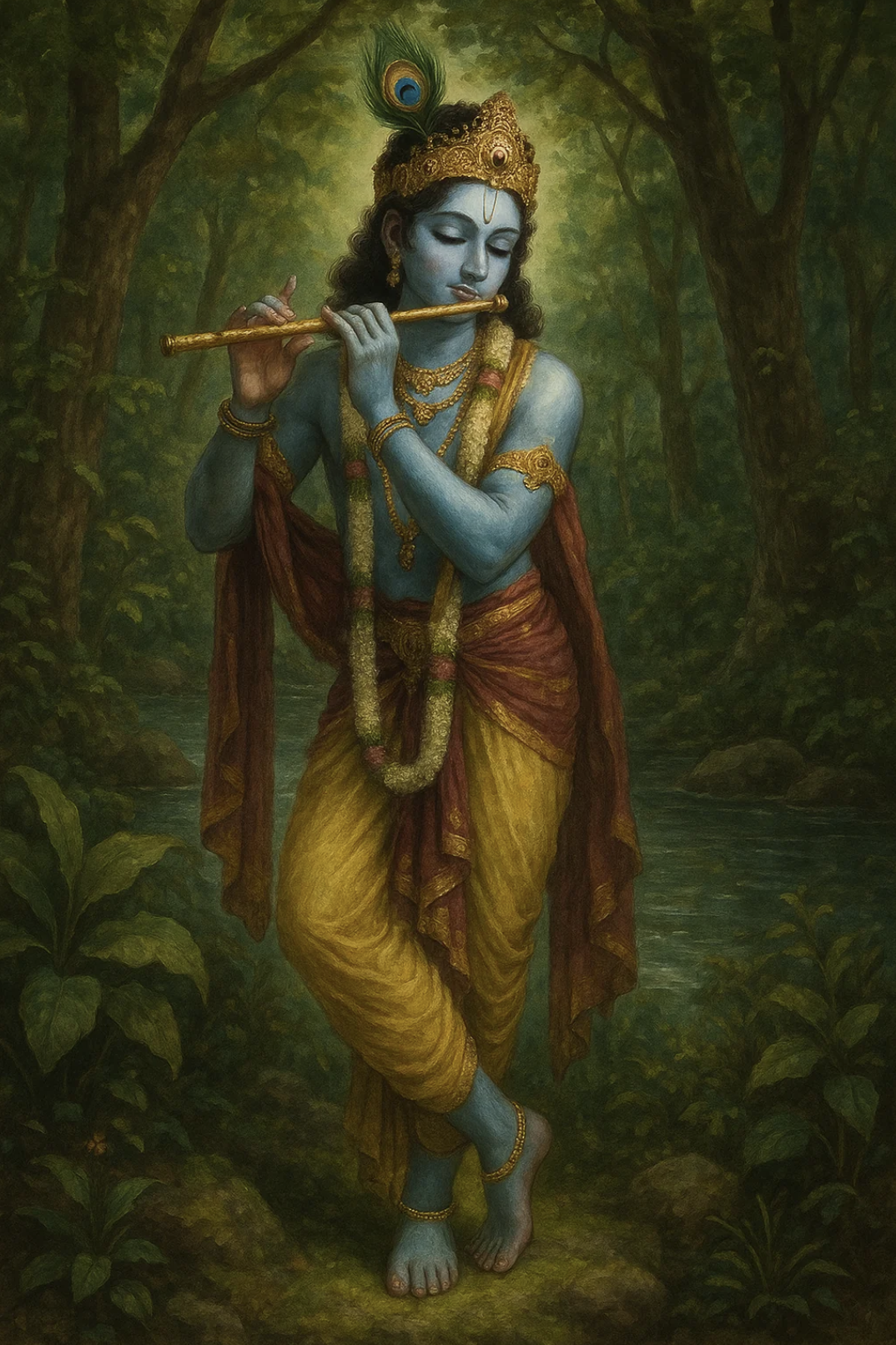

A retired doctor — whom Brahm Bodhi addresses as “Doctor Sahib” — wrote seeking guidance, describing a lifelong pull toward God and service in temples.
“Hari Sharanam. Since childhood I have felt naturally drawn toward God and service in temples. During my active professional life this remained one part of my life. After retirement I wished to devote all my time to the worship of Bhagavan, to pilgrimage and satsang. Yet my experience over the past few years has been that whenever I step outside that environment, I find myself back where I was before. It seems that I am still exactly as I was in childhood, with not the slightest change in my state of mind. Since childhood I have practised rigorous austerities, nama-japa, meditation and samadhi. I wish to understand what has been attained through all this, and what may ultimately be attained. Should a healthy body and mind be employed, while living amidst family and society, for the welfare of ordinary people? Or should one seek solitude for the pursuit of knowledge, detachment and devotion? Please guide me. Jai Shri Ram.”
“Hari Sharanam, Doctor Sahib,” Brahm Bodhi began. He gently observed that the seeker’s account and question were not entirely clear to him — particularly whether he meant that he had been experiencing samadhi since childhood — yet he offered a brief response to what he had understood.
No sadhana is ever wasted
First, Brahm Bodhi assured him, whatever japa, tapas, meditation, worship and spiritual practice one undertakes certainly bears some fruit. Whether little or much, nothing goes entirely to waste.
But the right means shorten the journey
Suppose, he said, one has to travel from Patna to London and begins walking in that direction. Every step is not wasted; one does move somewhat closer to the destination. But had one taken the right train and then the right flight, one would have reached there much sooner. Even a person who cannot afford an air ticket should, if he truly wishes to reach London, try to cut unnecessary expenses, work harder to earn a little extra, and somehow arrange the fare.
Most people, Brahm Bodhi observed, are travelling toward moksha on foot. Perhaps one person in a hundred thousand is even making a serious attempt. Whatever distance one has covered leaves its samskaras accumulated in the subtle body, and in the next birth one may get an opportunity to continue the journey — provided one is born again as a human being.
But it is equally possible, he cautioned, that next time one may begin walking in the opposite direction. And if one is born as an animal or a bird, who knows when a human birth will come again? It is therefore far better to complete the journey in this very lifetime.
A story: the fear of degradation
Brahm Bodhi recalled an acquaintance who happened to receive compensation of nearly ₹25 crore. Already well-off, the man now worried that in his next birth he might be born as a dog. Having studied the scriptures, he knew there is no guarantee that one’s next birth will necessarily be human. He asked Brahm Bodhi what he should do with those ₹25 crore so that he might avoid spiritual degradation — perhaps having read that some action once committed can result in birth in a canine form.
Once the gravity of the cycle of birth and death truly sinks into a person’s consciousness, Brahm Bodhi noted, he strives far more urgently to escape it.
That is why Bhagavan says in the Gita:
“जन्ममृत्युजराव्याधिदुःखदोषानुदर्शनम्।”
To contemplate repeatedly upon the suffering inherent in birth, death, old age and disease is itself spiritually beneficial.
Descriptions of hell, he added, are found not only in the Garuda Purana but also in the Bhagavata and several other scriptures. Even Yudhishthira had to witness hell in the Mahabharata, though only for a few moments — and we know that even he had committed certain wrongs. It is therefore best that we do not knowingly commit even a single wrongful act.
As real as this birth is, so is rebirth; so are heaven and hell. And moksha is the final liberation from this entire cycle.
This, Brahm Bodhi clarified, is not yet the answer to the doctor’s question. It is only the background necessary for understanding it.
Understanding the route before setting out
If we have to travel to a distant country, he said, we ask ten people how to get there, what means of transport to take, and where to stay. Why, then, should we undertake the journey toward moksha without first understanding the route?
The doctor’s central question, Brahm Bodhi acknowledged, is extremely important: Is it more spiritually beneficial to withdraw from worldly life and devote oneself full-time to bhajan and sadhana — or is the same spiritual attainment possible while living amidst family and society and working for the welfare of others?
He promised a direct answer to this question — but not on that day. He would take it up in small parts, so that everyone could understand it clearly.
For the present
For now, Brahm Bodhi advised, everyone should read the Bhagavata’s description of the hells and of the actions that lead to them. It will evoke a profound sense of fear — and even that fear can become a means to one’s spiritual welfare.
Turning to the seeker, he added with warmth that he knew the doctor personally — knew how honest and compassionate a physician he had been. What he had said about hell and spiritual degradation, therefore, was not directed at the doctor personally; it was meant for everyone.
The doctor was certainly deserving of sadgati, a blessed destination, Brahm Bodhi said. But one should not strive merely for sadgati — one should strive for the highest destination, the param gati.