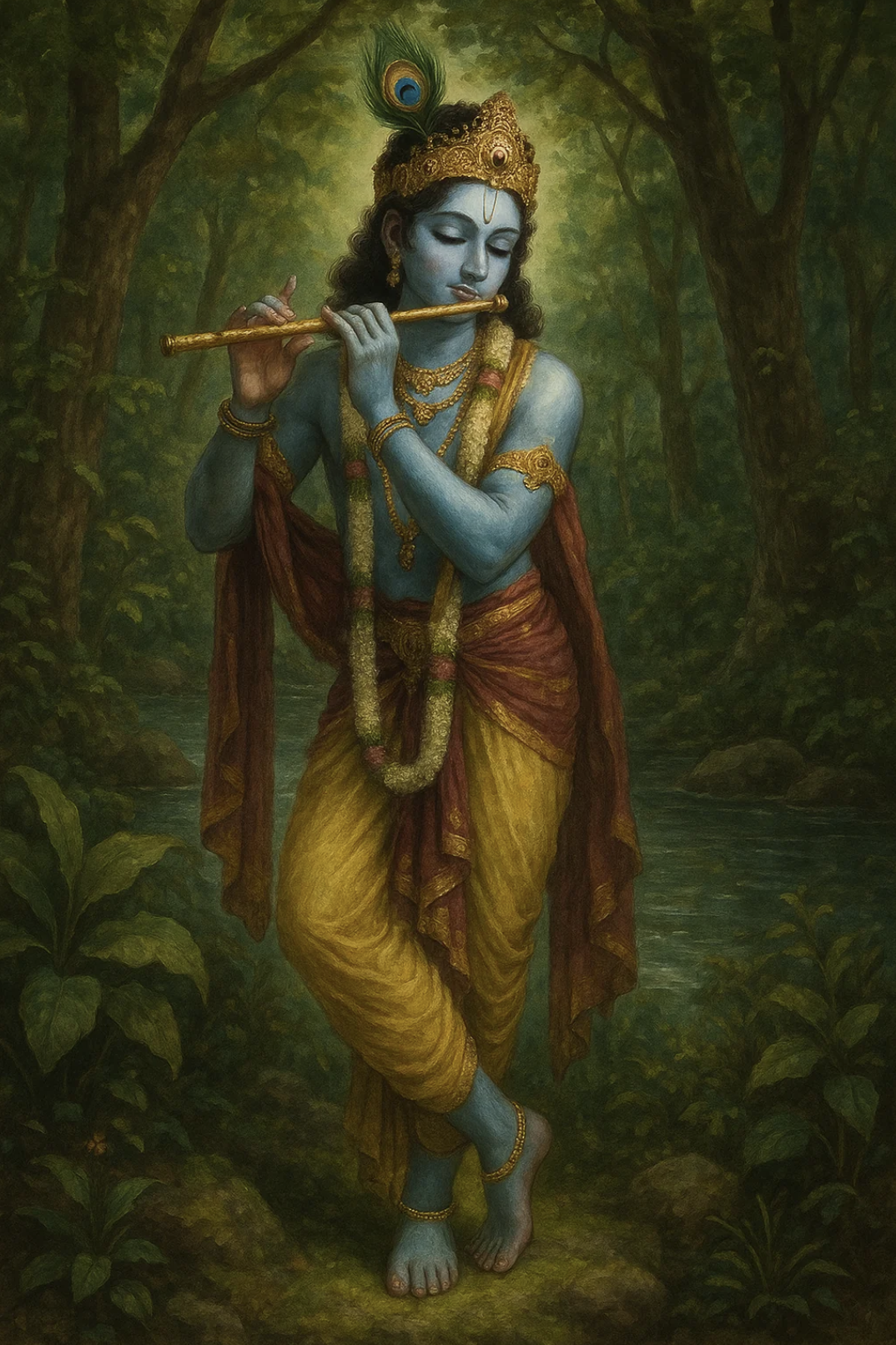

A seeker wrote to Brahm Bodhi with a thoughtful question about the opening chapter of the Bhagavad Gita.
“Jai Shri Radhe-Krishna! In verses 1.38 to 1.44 of the Srimad Bhagavad Gita, Arjuna speaks at length about the ruin that war will bring. Yet Bhagavan Sri Krishna neither dwells upon these points nor offers any comment on them. Were those considerations not worthy of reflection? What does the Mahabharata say about the later lives of the wives of those slain in the war? And since the Pandavas, by their age, were fit for the vanaprastha stage of life, would this vast slaughter not have been averted had the Lord simply guided them to live accordingly?”
“Hari Sharanam!” Brahm Bodhi replied, and took up the question with care.
First, understand Sri Krishna’s manner of dialogue
It is first necessary, he said, to understand Bhagavan Sri Krishna’s style of conversation. If a person keeps raising one question and argument after another, a wise one does not necessarily answer each separately. He tends instead to grasp the root problem hidden behind those questions, and answers that. This highly refined method is visible throughout the Gita: Krishna does not directly rebut each of Arjuna’s statements, but gradually lifts his thinking to a higher and wider plane.
It must also be remembered, Brahm Bodhi noted, that this was not a leisurely discussion held in the comfort of an ashram, reclining in an easy chair. Both armies stood ready for battle and lakhs of warriors were waiting. Krishna’s aim, therefore, was not to settle in detail every curiosity arising in Arjuna’s mind on the spot. His immediate purpose was to dispel the delusion (moha) and mental crisis that were causing Arjuna to shrink from his duty.
Which of Arjuna’s fears were valid?
One of Arjuna’s apprehensions was entirely correct: the war would cause terrible destruction. This needed no prophecy; it was evident from the vast armies standing before him. But alongside this, Arjuna went on to infer that with the men slain, the women would be left unprotected, the family dharma (kuladharma) would be destroyed, and varnasankara — a confusion of the social order — would arise. Krishna did not answer these inferences one by one, because he could see that history itself would answer them.
History itself answers Arjuna’s fears
The later narrative of the Mahabharata, Brahm Bodhi explained, gives its own reply. The Stri Parva poignantly describes the unbearable grief of the war-widows. Yet the Mahabharata presents no broad social picture in which war-widows, left destitute, wander helplessly and thereby give rise, on a large scale, to the “varnasankara” that Arjuna had imagined.
On the contrary, the Anushasana Parva clearly records that Yudhishthira gave abundant wealth to the women who had lost husbands and sons in the war. Even the women of the Kaurava family were not cast aside. The Ashramavasika Parva tells us that Dhritarashtra and Gandhari lived under the protection and honour of the Pandavas until nearly fifteen years after the war. And in the Mahabharata’s supernatural account, Vyasa even brings about a reunion of the slain warriors with their kin, and there is an episode in which the widows are offered the choice of departing to the realm of their husbands. In other words, the Mahabharata’s own story does not prove Arjuna’s apprehensions true; it does not show them unfolding as he had imagined.
Arjuna’s deeper problem
Arjuna’s root difficulty, Brahm Bodhi observed, was perhaps deeper still. At that moment he was viewing the war largely through a personal and familial lens: my grandsire, my teacher, my kinsmen, our lineage, our women, our families. This view was human, but incomplete. The other side was not yet sufficiently before him: what would become of the people (praja) — a society far larger than his own family — if the kingdom were left in the hands of one of Duryodhana’s disposition?
Krishna raises the vision to lokasangraha
Krishna does not bluntly tell Arjuna, “You are thinking only of your own family.” His method is more refined. He goes on to place before Arjuna the principle of lokasangraha — the holding-together and welfare of the world — and cites the example of kings such as Janaka:
“कर्मणैव हि संसिद्धिमास्थिता जनकादयः। लोकसंग्रहमेवापि सम्पश्यन्कर्तुमर्हसि॥”
That is: Arjuna too ought to act, keeping in view the welfare of the world.
Here the deeper answer to Arjuna’s question is found. The question was not merely how much sorrow the war would bring to his family. It was equally this: how much suffering might come to society and to the people if the war were not fought? Sometimes personal and familial sorrow must be accepted for the sake of the wider welfare of all.
Why retiring to the forest was not the solution
From this same standpoint, Brahm Bodhi continued, the suggestion that the Pandavas should simply take up vanaprastha was not an adequate solution either. First, it is not correct to assume that every kshatriya king, on reaching a certain age, was obliged to relinquish rule and retire to the forest. In fact, the practice of kings and others entering the vanaprastha and sannyasa stages is not strongly borne out by history and the Puranas. Our very highest ideals, Sri Rama and Sri Krishna, accepted neither the vanaprastha nor the sannyasa ashrama.
Second, and more importantly: had the Pandavas gone away to the forest, their own personal struggle might have ended, but the plight of the people living under Duryodhana’s rule would not. If those who have the capacity to resist injustice withdraw merely to spare themselves and their families sorrow, that would indeed be renunciation (tyaga) — but would it also be lokasangraha?
The heart of Krishna’s answer
This is why Krishna does not refute each of Arjuna’s inferences in 1.38–44 one by one, like a court of law. He effects a far more fundamental change: he raises Arjuna’s vision from “I and my family” to svadharma, to selfless action (nishkama karma), and ultimately to lokasangraha.
Some of Arjuna’s fears were valid — the war was indeed terribly destructive. But not every one of his fears was borne out by history. And Krishna’s comprehensive answer was this: the question of dharma cannot be decided solely on the basis of which option is less painful for me and my family; one must also consider what one’s duty is for the sake of the wider society and the welfare of all.